The Local Monastery and Its Hermitage
The Brothers KaramazovThe Local Monastery and Its Hermitage are both a physical setting for the novel’s religious life and a contrast between forms of that life. The monastery offers Alyosha a place of peace and holiness, yet his return to the hermitage brings him face to face with Father Zossima’s decline and the uncertainty of what lies beyond the enclosure. Its communal confession and the solitary, rule-exempt existence of Father Ferapont show that the same religious landscape contains sharply different ways of inhabiting spiritual discipline.
Setting and Religious Community
After leaving the monastery, Alyosha crosses a pine wood to reach the hermitage. The journey links the two parts of the religious complex through a stretch of natural landscape, but the destination is not an ordinary refuge: the hermitage door is opened to him despite the rule that no one should be admitted at that hour. His arrival is marked by a tremor in his heart, an emotional response that gives the place a charged significance even before he learns what has happened there.
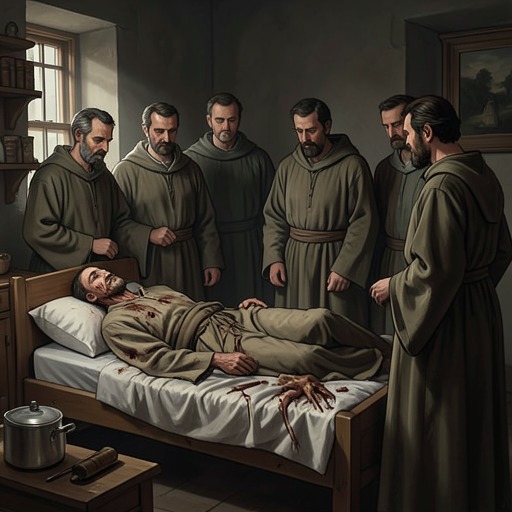
The monastery and hermitage are organized around a community that attends closely to the elder. In Father Zossima’s cell, Alyosha finds the novice Porfiry and Father Paissy, who comes every hour to inquire after the sick man. Their repeated visits make the cell a center of shared attention: Father Zossima’s condition affects not only his closest companions but the wider religious household.
The Cell and the Ritual of Confession
The hermitage cell is also the customary setting for a distinctive evening practice. After service, the monks flock to Father Zossima’s cell and confess aloud the sins of the day, sinful thoughts and temptations, and even any disputes among themselves. Confession here extends beyond acknowledged wrongdoing to the ordinary frictions and inward struggles of communal life. The practice makes the cell a place where private failings are spoken before others rather than kept concealed.
That ritual is disrupted by Father Zossima’s worsening illness. On the day Alyosha returns, even the elder’s usual discourse with the brothers cannot take place. The absence of a familiar gathering is therefore more than a change in schedule: a practice through which the community has voiced and shared its daily burdens is interrupted precisely when the elder at its center is becoming weaker. The scene binds the monastery’s collective life to the precarious condition of one man.
Father Zossima’s Illness and the Monks’ Vigil
Father Zossima is conscious and mentally clear, but he feels very weak and wants to rise only to sit in a chair. His face looks tired, yet retains an almost joyful brightness, with an expression of gaiety, kindness, and cordiality. The contrast between his failing strength and his composed, welcoming manner shapes the cell as a place of vigil rather than simple despair.
Outside it, the monks crowd together in excitement and suspense. When Alyosha briefly leaves the cell, he sees their anticipation expressed differently: some are anxious, while others show devout solemnity. The community’s attention thus moves between the elder’s immediate bodily condition and the meaning his presence holds for those waiting around him. The hermitage becomes a shared space of uncertainty, where personal concern and religious expectation coexist.
Contrasting Forms of Monastic Life
Father Ferapont lives in the hermitage but does not visit Father Zossima. The other monks do not press him to observe the hermitage’s regulations, in part because he behaves as though he were crazy. He is at least seventy-five and occupies an old, decaying wooden cell in a corner beyond the apiary. His residence belongs to the same religious setting, but his distance from the elder’s cell and from its communal routines makes his way of life markedly separate.
The contrast is not simply between a resident and an outsider: Father Ferapont inhabits the hermitage itself, yet stands apart from its ordinary discipline and gathering. Father Zossima’s cell draws monks into confession, conversation, and mutual attention; Father Ferapont’s corner beyond the apiary is associated with withdrawal and exemption from the regulations. Together, these details present the monastery and hermitage not as a uniform sacred enclosure but as a setting where communal practice, spiritual authority, illness, and solitary eccentricity meet.